Many magazine and news articles
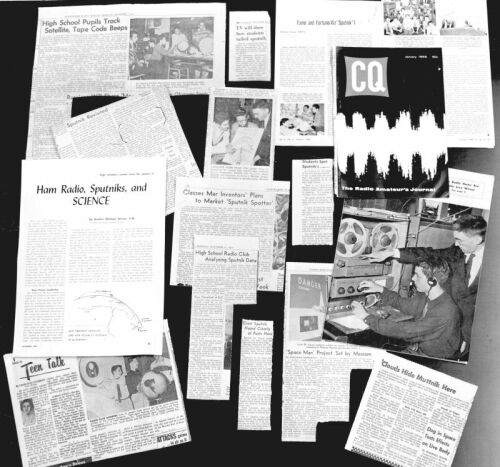
covered the adventures of the St Joe's Radio Club gang tracking the very first orbiting space satellites
Sputnik and Sputnik-2 launched by the Russians in the Fall of 1957, and Sputnik-3 launched in May, 1958:
Sputnik: October 4, 1957, the first orbiting Satellite
Sputnik-2: November 3, 1957, --with dog Leika
Sputnik-3: May 15, 1958, --a massive 3,000 pounds
An oscilloscope photo of the first Sputnik "beeps" recorded on tape by the club
made the cover for their feature story in January 1958 CQ magazine, which was later remembered in the
October and November 2007 issues of that magazine for the 50th Anniversary Year.
In all, the St Joe's Radio Club had gotten onto 7 TV shows and were covered in more than 30 radio news stories
and 20 newspaper articles, before they stopped counting.
The students literally got their "fifteen minutes of fame"
by relating their adventures "live" on WEWS TV-5 in Cleveland, on Sunday Dec 1, 1957.
That included movie footage
taken while they were doing the actual Sputnik tracking.
The movie was later made into a science visual-aid film.
Sputnik and the ensuing space-race produced an explosion of interest in Science and Engineering as choices of
study that extended well beyond the 1960's race to put a man on the moon!
In the years that followed, the students were repeatedly on TV-5 programs with their own Science Fair projects!
--no doubt positively influenced by this experience, but in the end it was the fantastic radio club that
gave them a can-do attitude and convinced them that anything was possible.
Besides amateur radio, their moderator and mentor Mike Stimac encouraged them to obtain Commercial
Radio Operator Licenses "as a backup" to any career or job they might pursue. But this group was
especially linked by an event that would thereafter cause all broadcasting and communications
to be dependent on satellites and "rocket science." On the heals of Sputnik, an Aircraft Training and Flying Program followed!
Then in 1960 Mike was being sent to Africa to start a Flying Mission for Medical Aid and make it self-sustaining.
Things looked dire for the Club here in the States. But they rallied, and Mike's projects
over there became their projects as well! Gathering donations of ham radio equipment, battery powered tools, etc, and
shipping them to help Mike build stations and train the natives to have better communications, while he also started the flying program
there to provide better medical aid. Meanwhile, the kids here just proceeded with their plans and moved on to "Moonbounce"!
--so it went. --each class moved on, but with a "STEM" headstart in their technical pursuits.
Thus, several worked as Avionics and Communications Technicians, and in Broadcasting to finance their educations, and moved on to
becoming Chief Engineers in Radio and TV, University Professors, Science Researchers, Medical Doctors, Inventors, and some who went into
the Military then continued into the Defense Industry. One ended up as a Project Director at NASA. Ironically one of them who appeared on
our WEWS-TV Sputnik Program ended up as the Director of Engineering for that same station, and won an Engineering Emmy for the opening of the
Rock and Roll Hall Of Fame!
Talk about the STEM program these days?
Mike Stimac did it in the 1950's! --We LIVED it!
and today, because of Mike,
|
WINGS of HOPE SOARS into STEM! |
St. Joe's High School
Radio Club
Cleveland, Ohio
Call Letters:
W8KTZ
TRACKING SPUTNIK!
The St Joe's High School Radio Club (SJHRC) prevailed from 1951 to 1979.
During that time about 150 students learned Morse Code, got licenses,
built and repaired transmitters and receivers, and performed public-service work, such as
providing communications for special events, conducting Halloween Vandal Patrols,
participating in Civil Defense drills and RACES --the Radio Amateur Communications Emergency Service.
On October 4, 1957, the Russians jump-started the "Space Race" by launching Sputnik,
the first space satellite!
The students had tunable receivers, rotate-able antennas, and the manpower to
immediately start tracking the signals; --and they recorded the beeps on magnetic tape,
and immediately noticed and reconciled the "Doppler Shift" of the RF carrier!
The tracking stations for the "official" planned U.S. satellite launch program
were equipped with dedicated fix-tuned receivers
and special antennas set for 110 MHz and NOT the
"more accessible" 20.005 MHz and 40.002 MHz frequencies the Russians blatantly had chosen for
their worldwide public-relations coup!
By the time the U.S. Govt. (Navy) equipment could be changed over, the SJHRC had recorded
thousands of feet of tape.
Sputnik was battery-powered, and the 20 MHz signal started to falter
in just 8 days. Each of the signals came from a separate power-hungry Vacuum Tube Transmitter
as transistors were only just being developed.
When the FBI came to take the 20,000 feet of tape for analysis,
they said the club even beat the Navy station by 4 hours!
On November 3rd the Russians launched Sputnik-2 with a dog Laika on board.
By this time, the boys had even invented the "Orbitometer" --a circular slide rule, to predict with great accuracy,
the location of the satellite at any time. School officials started pursuing the idea of a patent.
On May 15, 1958, a massive 3,000 pound Sputnik-3 was launched!
Instead of beeps, it seemed like the guys now heard telemetry coded in the form of a Morse code "L" --diDAHdidit--
perhaps chosen in memory of Laika! --or maybe it was just a coincidence due to the pulse-width coding of the beeps.
Listen for yourself by selecting the "Sputnik Beeps" tab.
Clearly Mike had developed more than STEM in the 50's, adding inventing and patenting, as well as publicity to the mix!
--R. A. Leskovec, K8DTS
|


 Remembering the heyday of Ham Radio, and SPUTNIK --the Birth of the Space Age.


 MOONBOUNCE!